
The Mythic Pattern of Decline: When Power Turns Against Itself
The Inward Turn of Decline
Civilizations rarely narrate their decline as a result of external conquest. More often, historical and literary records suggest a darker process: power turning inward, consuming the very institutions and norms that once legitimized it. This pattern is not merely allegorical; political science and historical sociology have long recognized the dangers of institutional sclerosis, captured in concepts such as “path dependency” (Pierson, 2000) and the “iron law of oligarchy” (Michels, 1911). Myths, far from escapist fantasy, encode these patterns symbolically, providing a lens to analyze contemporary governance failures.
Cronus and the Fear of Succession
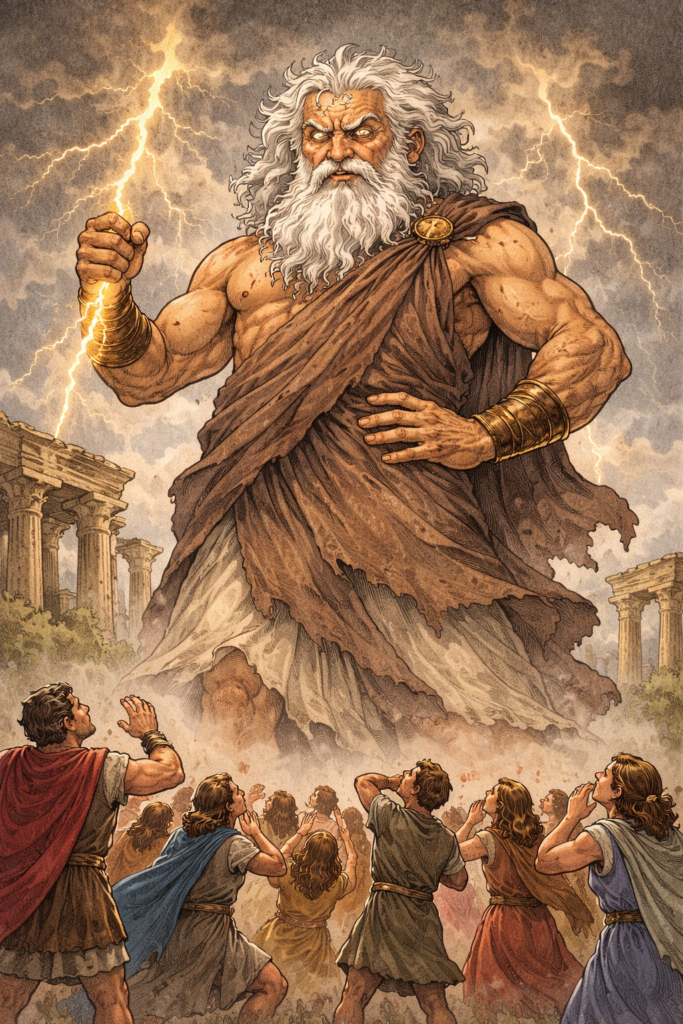
The Greek myth of Cronus illustrates the dynamics of power resisting temporal change. Cronus, warned that his children will overthrow him, swallows them at birth. In Greek thought, he is conflated with Chronos—time itself—emphasizing the tension between authority and succession. His crime is not simple cruelty; it is an attempt to arrest historical processes that threaten entrenched power.
Modern analogues exist. International institutions—ranging from the United Nations and the International Criminal Court to multilateral trade agreements—were originally designed to evolve with shifting political realities. Yet entrenched powers often treat these mechanisms as immutable, interpreting adaptation as a threat to stability or authority. Reform becomes delegitimized, and efforts to adjust to social, environmental, or economic change are resisted. In attempting to preserve the present, authority consumes the conditions necessary for its future, producing a brittle system: one that survives structurally but loses functional legitimacy (North, 1990).
The Swallowing of Law
International law exemplifies this dynamic. Designed to constrain unilateral action and provide predictability, law is instrumentalized when it begins to limit the discretion of powerful actors. States may invoke “exceptional circumstances” or “temporary measures” to bypass norms, often indefinitely. In doing so, legal frameworks persist as ceremonial artifacts but lose binding authority, echoing Cronus’s devouring of his offspring.
This is not lawlessness. It is something worse: legality without constraint. The system retains the appearance of order while neutralizing the normative pressures that make law effective, a phenomenon observed in contemporary debates over executive overreach, the erosion of treaty compliance, and selective application of international law.
Post-Truth and the Collapse of Meaning
Shakespeare’s King Lear offers a parallel insight into the epistemic erosion of authority. Lear demands affirmation rather than truth; power seeks reassurance over reality. Modern analogues are evident in post-truth politics, where factual knowledge is subordinated to narrative control. Elections, judicial rulings, and media reports continue to function formally, yet their perceived legitimacy diminishes when they fail to constrain or guide power. Authority persists even as the meaning of its actions disintegrates (D’Ancona, 2017).
Knowing the End Without Changing Course
Norse mythology reinforces the warning. In Ragnarök, the gods are forewarned of destruction but fail to act effectively, choosing heroic endurance over structural adaptation. This motif resonates with contemporary challenges: governments and institutions receive detailed forecasts on climate change, economic inequality, and democratic erosion, yet meaningful reform lags. Awareness substitutes for action, and knowledge alone does not prevent systemic decline. The myth illustrates the limits of preparedness when institutions are unable or unwilling to adapt.
The Closed Loop of Power
The Ouroboros—the serpent devouring its own tail—represents the end-stage of institutional sclerosis. Systems reference themselves for legitimacy; information circulates without producing understanding. Procedures continue, offices remain occupied, and authority is reaffirmed, but functional capacity to correct errors is lost.
Across these myths, post-truth politics is not the cause of decline, but its symptom. It emerges when power can no longer adapt to time, tolerate succession, or accept limits on its authority. Truth becomes a liability rather than a foundation. Reality is no longer something to be engaged, but something to be managed.
Facts are not erased; they are fragmented. Law is not abolished; it is performed. Institutions persist as stages for legitimacy rather than sources of constraint. Information multiplies while understanding diminishes. The result is a carefully maintained unreality that allows power to endure without meaning.
Restoring the Future
Historical and theoretical scholarship suggests a counterintuitive lesson: renewal does not arise from destruction but from liberation of the constrained. Institutions regain authority when allowed to function independently of entrenched power; law binds only when it limits coercion; truth regains force when it is insulated from manipulation.
Power that cannot coexist with time will always falter.
Power that cannot tolerate truth will govern blindly.
Power that consumes its own future ensures that its end will be abrupt and violent rather than evolutionary.
No system can survive by devouring its own future. Only by restoring autonomy to norms, institutions, and epistemic structures can governance achieve resilience.
© 2026 IustitiaLab — All rights reserved