
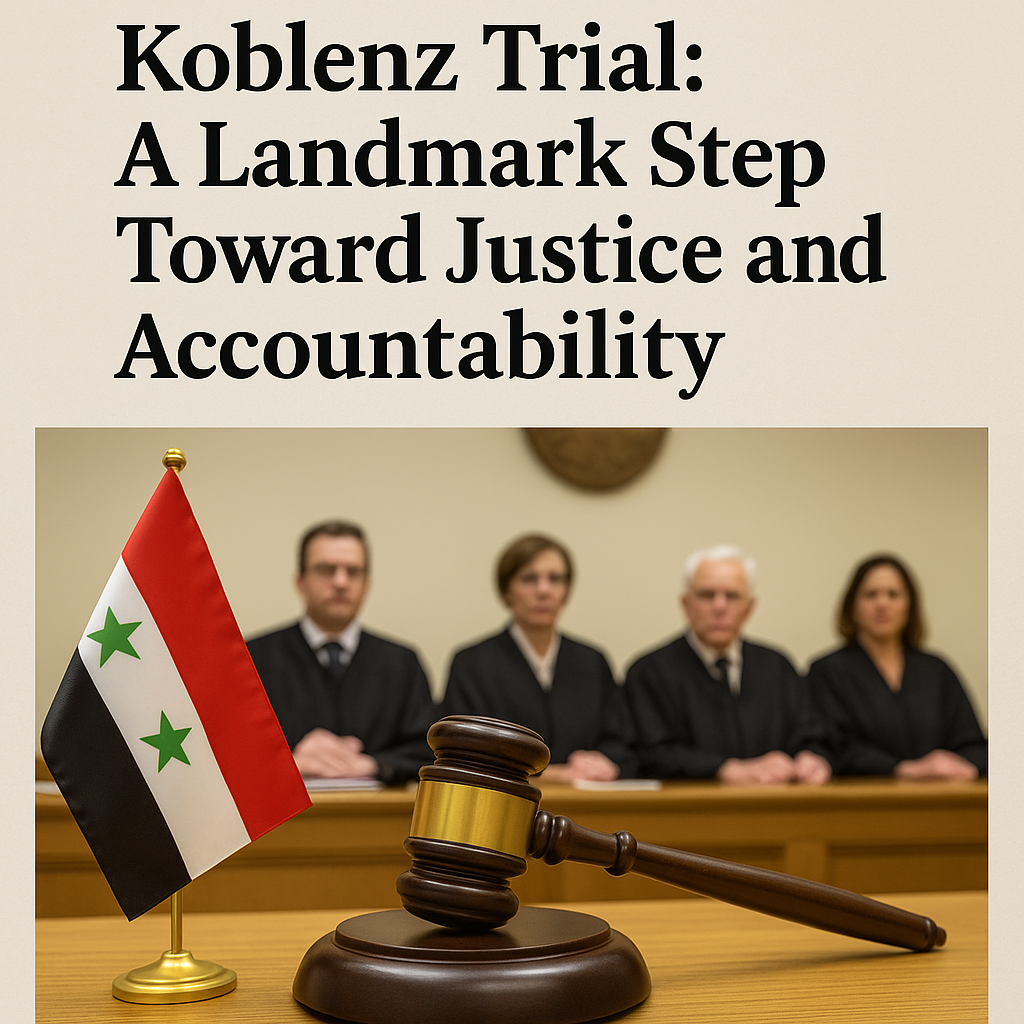
Why the Koblenz Trial Matters: A Watershed for Justice, Accountability, and Peace
The Koblenz trial marked a historic moment for survivor-led justice, universal jurisdiction, and the global struggle against impunity for crimes against humanity.
Universal Jurisdiction in Action: Justice Without Permission
The Koblenz trial was possible because of universal jurisdiction — the legal principle that allows states to prosecute grave international crimes such as genocide, torture, and crimes against humanity regardless of where they occurred or the nationality of those involved. Germany’s Code of Crimes Against International Law (VStGB) made it possible to try a Syrian official without waiting for:
- a UN Security Council referral,
- an ICC investigation,
- or a regime change in Damascus.
This was more than a courtroom victory — it was a legal breakthrough. It proved that justice does not have to wait for peace. It can begin now, wherever jurisdictions remain open, wherever survivors speak, and wherever the law has the courage to reach beyond borders.
The First Crack in the Wall of Impunity
For half a century, the Assad regime operated with total impunity. Torture was state policy — industrial, systematic, and brutally ordinary. For decades, the world turned away.
Koblenz changed that.
Anwar Raslan was not the ultimate perpetrator — but he became the first to face legal consequence. This case sent a message far beyond Germany:
“The world is watching. Justice is slow — but it is coming.”
Every confession, every witness testimony, every piece of evidence used in Koblenz is now part of the historical record. The wall of impunity did not collapse — but it cracked. And every crack matters.
Survivor-Led Justice: Dignity Beyond the Verdict
One of Koblenz’s defining achievements was its survivor-centred design. Survivors were not tokens inserted into a legal process — they built the process. They:
- filed the criminal complaints,
- partnered with ECCHR and Syrian human rights groups,
- provided evidence and expert testimony,
- navigated the emotional violence of reliving torture publicly,
- and insisted that justice acknowledge their dignity, not only their suffering.
Some testified anonymously to protect relatives still inside Syria. Others chose to speak openly, refusing to be erased any longer.
The Koblenz trial did not only establish legal accountability — it acknowledged, recognised, and honoured the experience and courage of victims and survivors. By placing their testimonies at the centre, the court affirmed that their suffering matters, their voices carry authority, and their courage in speaking out is itself a form of justice.
“They thought we were weak because we fled. But we came to court — and the regime is on trial.”
Koblenz transformed memory into evidence, trauma into testimony, and witnesses into legal actors. It is now a global model for survivor-led accountability — not top-down, but built from the bottom up — and a reminder that justice begins with those who endured the crime.
Documenting Violence: The Power of Evidence
The Koblenz trial did not happen by accident. It was the result of a decade of documentation by Syrians and international civil society — often at immense risk. Evidence included:
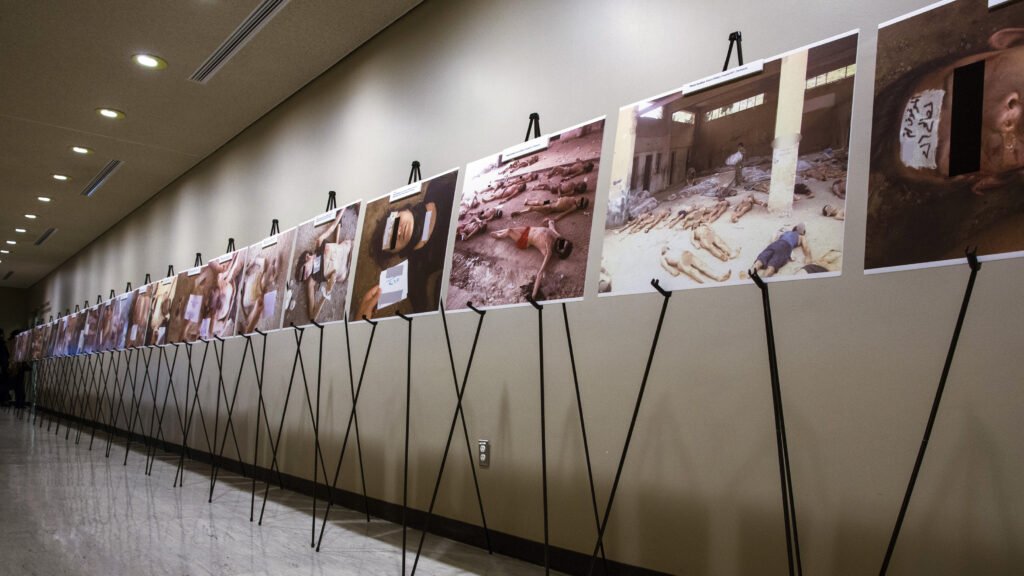
- the Caesar photos documenting mass torture and death
- thousands of witness interviews
- smuggled regime documents
- expert analysis of the Syrian intelligence structure
- testimony from defectors and forensic specialists
This trial proved something essential: Documentation is not futile. It is the seed of future justice.
And it offers lessons now being applied to Gaza, Myanmar, Sudan, Xinjiang, Ukraine, and beyond:
- gather early,
- verify rigorously,
- preserve chain of custody,
- protect witnesses,
- archive ethically,
- and prioritize survivor testimony from the beginning.
Koblenz demonstrated that civil society can build a criminal case even when states refuse to act.
Justice and Peace: Not Sequential, But Intertwined
Traditional diplomacy insists that justice must wait for peace. Koblenz fundamentally rejected that logic.
The trial demonstrated that:
- holding perpetrators accountable prevents future violence
- acknowledgment of crimes is a prerequisite for real reconciliation
- survivor dignity and historical truth are foundations of sustainable peace
“Peace built on silence is not peace — it is deferred violence.”
The lesson is clear: The road from war to peace must pass through truth.
Koblenz Is Not Enough — But It Is Essential
What the trial did not do:
- ✘ It did not prosecute Assad or top leadership
- ✘ It did not cover the full range of Syrian crimes (chemical attacks, siege warfare, starvation)
- ✘ It did not deliver comprehensive reparations
- ✘ It did not erase trauma
What it did do:
- ✔ It shattered the myth of total impunity
- ✔ It created a legally verified historical record
- ✔ It empowered survivors as legal protagonists
- ✔ It established universal jurisdiction as a working pathway
- ✔ It inspired parallel cases in Europe and beyond
Symbolic victories matter. Precedents matter. Legal cracks matter. Koblenz built the infrastructure upon which future justice will depend.
A Model for Future Accountability
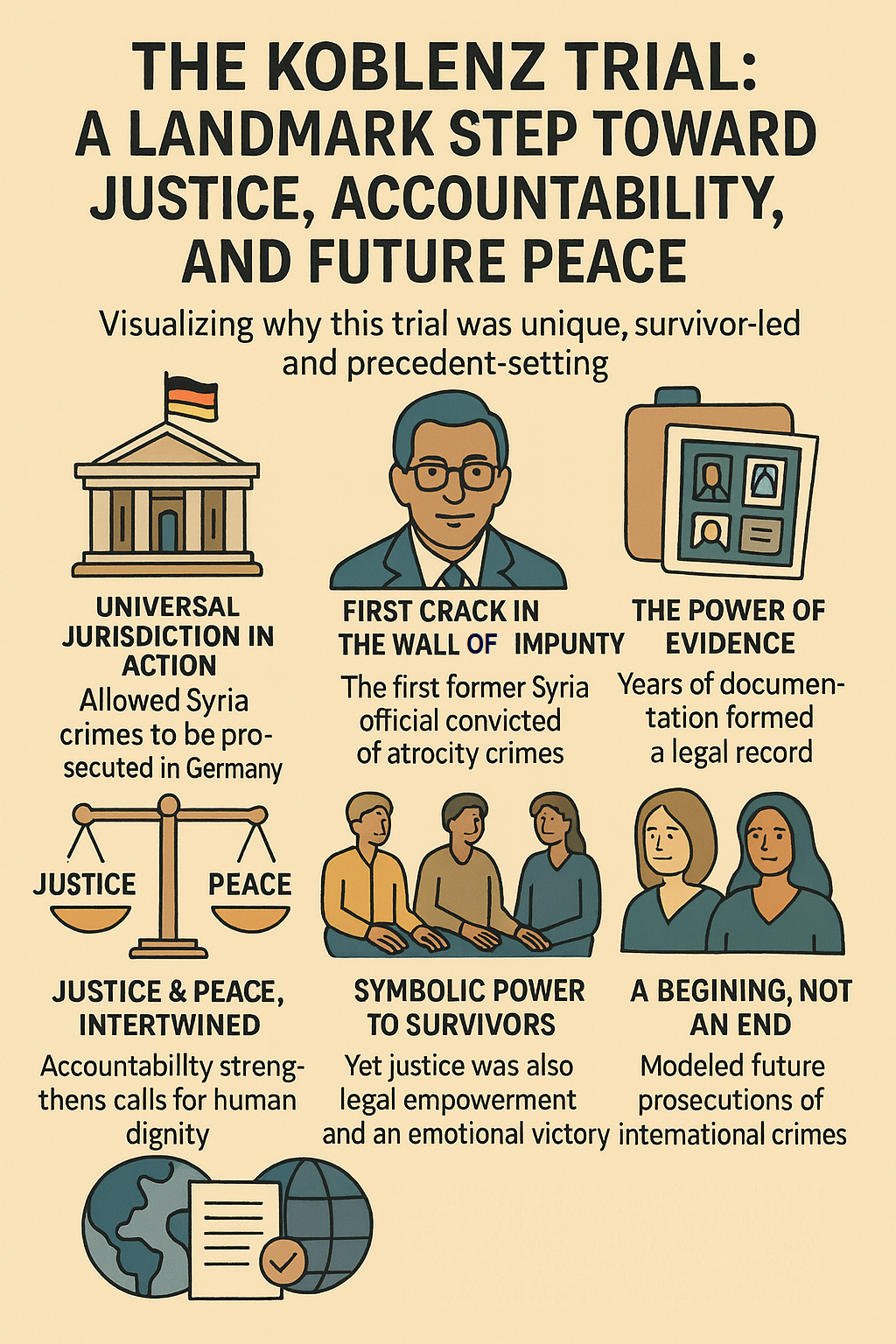
Koblenz now serves as a prototype for justice in a blocked world — a model that is already being replicated. The trial demonstrated:
- Survivor-driven strategy
- NGO-led investigations
- Independent domestic courts
- Universal jurisdiction as a functional tool
- Innovative use of documentation
Its ripple effects are visible in:
- Yazidi genocide trials in Germany
- Rohingya universal jurisdiction cases in Argentina
- European war crimes cases related to Ukraine
- Investigations into Russian, Sudanese, and even Israeli and Hamas officials
- Preliminary discussions on using UJ for Gaza war crimes
Koblenz is no longer simply a Syrian case. It is a template for a new era of accountability.
The Emotional and Symbolic Power of Koblenz
Legal impact alone does not capture the importance of the trial. For survivors, Koblenz was also:
- a reclaiming of voice
- a rejection of erasure
- a step toward restored humanity
“I feel human again. They can no longer deny what they did to us.”
Justice does not erase trauma — but it dignifies memory. It cannot undo torture, bring back the disappeared, or restore the years stolen in a prison cell. It cannot give survivors back the lives they might have lived.
But what justice can do is transform pain into testimony, memory into truth, and private suffering into public recognition. It affirms that what happened was real, unlawful, and morally intolerable. It shifts the burden of shame away from the victim and places it where it belongs: on the perpetrator.
In doing so, justice turns memory from a wound into a form of resistance — a record that refuses erasure, and a foundation on which future peace can be built. It replaces silence with testimony. It replaces invisibility with recognition. It transforms pain into historical truth.
The Koblenz trial did not only establish legal accountability — it acknowledged, recognised, and honoured the experience and courage of victims and survivors. By placing their testimonies at the centre, the court affirmed that their suffering matters, their voices carry authority, and their courage in speaking out is a form of justice in itself.
This too is peace.
A First Step — and a Necessary One
The Koblenz trial is not justice complete, but justice in motion. It proved that:
- crimes against humanity can be prosecuted even without an international tribunal
- survivors are credible, powerful agents of justice
- domestic courts can become arenas for global accountability
- truth can be legally established even when politics is paralyzed
The verdict in Koblenz is the first crack in the wall — but without it, the wall might still be untouched.
For Syria, for future conflicts, and for all who fight to defend human dignity, the Koblenz trial is a landmark — and a beginning. It is a declaration that even in a world of geopolitical paralysis, justice is possible.
And that justice is not the end of violence — but the beginning of peace.
@IustitiaLab 2025 – All rights reserved