
Homes Lost, Futures Denied: Housing, Land, and Property Rights as the Core of Social Justice in Syria
Introduction: Beyond Shelter
When wars end, the destruction is usually counted in lives lost, towns razed, and economies collapsed. Yet beneath these immediate devastations lies another form of loss, one less visible but equally enduring: the loss of housing, land, and property (HLP). In Syria, this loss is not only a humanitarian crisis but a social justice challenge that will define the possibility—or impossibility—of rebuilding.
For millions of Syrians, homes are not just physical structures but repositories of memory, dignity, and belonging. Without secure HLP rights, displacement becomes permanent, exclusion deepens, and reconciliation grows distant.
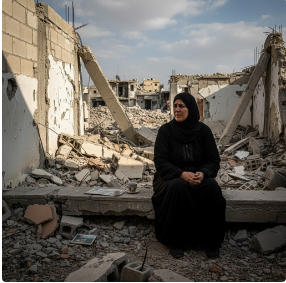
Consider the story of Fatima, a widow from Homs. She fled her neighborhood in 2014 when shelling reduced much of it to rubble. Her husband, who held the title to their small family home, was killed. Years later, when Fatima attempted to return, she discovered her land had been rezoned under new urban planning laws. Officials told her she lacked the proper documentation to prove ownership.
“They told me the papers were not valid, that I had no proof,” Fatima recalls. “But my children grew up in those rooms, my family lived there for generations. Now, I am told I am a stranger to my own house.”
Fatima’s story is emblematic of millions. The Syrian conflict has produced not only the world’s largest refugee crisis but also one of the most complex HLP crises in modern history.
The Scale of Displacement
Syria’s war has displaced over 12 million people—more than half the country’s pre-war population. Of these, about 6.8 million remain internally displaced, while another 5.4 million are refugees, mainly in Lebanon, Turkey, and Jordan.
For many, return is not simply a matter of crossing a border. Their homes have been destroyed, looted, or confiscated. Entire neighborhoods have been demolished under urban planning schemes. Others face secondary occupation, where homes are taken over by militias, local authorities, or new residents.
This is not merely about material shelter. In the Middle East, as elsewhere, property embodies social standing, inheritance, and community belonging. The erasure of one’s home reverberates through identity itself. Fatima does not only lose walls and a roof—she loses the possibility of being rooted in her community again.
Legal Frameworks and Barriers
HLP rights in Syria are complicated by a patchwork of legal instruments that have, in practice, deepened dispossession.
- Law 10 of 2018 allowed the government to designate redevelopment zones. Property owners in these areas had only 30 days to prove ownership—an impossible task for many who fled under fire. Those who failed risked expropriation without compensation.
- Decree 66 of 2012, a precursor to Law 10, authorized large-scale demolitions in Damascus suburbs to pave the way for luxury real estate developments.
- Lack of documentation compounds the problem. Before the war, much of Syria’s housing, especially in informal urban settlements and rural areas, was unregistered. Displaced families often fled without deeds, and government buildings housing property records have been destroyed.
- Gender inequality adds another layer. Many deeds were registered in the names of male heads of households. Widows like Fatima struggle to prove inheritance, especially in patriarchal legal systems that require male witnesses or extensive documentation.
Thus, while international law recognizes the right to restitution and return, Syrian legal frameworks—combined with the realities of war—make these rights inaccessible.
HLP as Social Justice
Why does HLP matter for social justice? Because property is not just an economic asset; it is the basis of dignity, identity, and security. To be dispossessed is to be rendered invisible, without claim to belonging.
International norms underscore this. The Pinheiro Principles—UN guidelines on restitution for refugees and displaced persons—emphasize that the right to return and reclaim property is fundamental for justice after conflict. Without it, displacement risks becoming permanent, exclusion institutionalized.
Fatima’s exclusion from her own home exemplifies this dynamic. She is denied not only shelter but recognition as a citizen with rights. The loss of her home cements her marginalization, both socially and politically.
Stories of Loss and Injustice
Fatima (Homs):
Her attempt to return was thwarted by rezoning laws. Without her husband’s papers, and with bureaucratic barriers designed to exclude, she is left in limbo.
Ahmad (Aleppo, now in Lebanon):
Ahmad fled to Lebanon in 2013. His house in Aleppo was in an informal settlement, built without permits but with tacit recognition from local authorities. Today, those neighborhoods have been demolished. “They say my house never existed,” he laments. “But I was born there.” Ahmad’s predicament highlights how the informal housing sector—home to millions—has been erased by legal fictions.
The Suleiman Family (Damascus Suburbs):
Their neighborhood was demolished under Decree 66, with promises of modern housing developments. The family received no compensation. “They built towers for the rich on the land where our house stood,” Mrs. Suleiman explains. “We are now renting a single room in the countryside. They call it development, but it is exclusion.”
These stories illuminate the same pattern: the transformation of war-induced displacement into permanent dispossession.
Comparative Lessons
Syria is not the first conflict where HLP has been central.
- In Bosnia, unresolved property claims kept displacement festering for years after the war, until international mechanisms facilitated restitution.
- In Iraq, property disputes following sectarian conflict delayed reconciliation and return.
- In Palestine, the Nakba of 1948 created a refugee crisis still unresolved after seven decades, rooted in denied property rights.
The lesson is clear: ignoring HLP issues turns war displacement into generational injustice. Syria risks repeating this pattern on a scale unseen before.
The Role of Social Justice
Social justice in Syria cannot be achieved without addressing HLP. To rebuild society is to rebuild belonging, and belonging is rooted in place. Homes are where intergenerational memory resides, where rights are made tangible.
Fatima’s claim to her home is more than a private grievance—it is a demand for recognition. Her loss is not only personal but emblematic of structural injustice. As long as Syrians remain dispossessed, any talk of national reconciliation will ring hollow.
Moreover, unresolved HLP perpetuates inequality. Reconstruction projects favor elites and government-aligned investors, while ordinary Syrians like Fatima are excluded. This creates what some analysts call “exclusionary reconstruction”—a process that consolidates inequality rather than heals it.
Pathways Forward
What would justice look like for Fatima and millions like her? Several steps are essential:
- Documentation and Registration: Establishing mechanisms to recognize lost or informal property rights. This could include community testimony, satellite imagery, or alternative proofs.
- Restitution and Compensation: Following models from Bosnia and Kosovo, Syrians must have the right to reclaim or receive fair compensation for lost property.
- Gender-sensitive Reform: Ensuring women have equal standing in property claims and inheritance. This requires both legal reform and social change.
- International Guarantees: HLP rights cannot be left to domestic actors alone. International frameworks and monitoring are necessary to prevent expropriation masquerading as development.
- Inclusion in Peace Negotiations: HLP must be central to any political settlement, not a footnote. Without it, returns will be partial, reconciliation superficial.
Conclusion: Homes as the Foundation of Peace
As Syria gradually moves towards transition and recovery, the question of homes and land will determine the depth and durability of peace. Without addressing HLP, millions will remain in exile or marginalized in their own country.
Fatima’s voice captures this urgency:
“They can take away my papers, but they cannot take away my memory. I know where my house stood. I want my children to know they had a place.”
Her words remind us that housing, land, and property rights are not bureaucratic details. They are the foundation on which dignity, belonging, and community are rebuilt. A peace process that ignores them risks creating only silence, not reconciliation. If social justice means anything in post-war Syria, it must begin with the right to come home, unlock a front door, and believe that the ground beneath one’s feet will not be taken away again.
© 2025 @IustitiaLab — All rights reserved